
Navigating the Cloud and AI Development Act (CADA)
The European Commission has unveiled the Cloud and AI Development Act (CADA), a landmark legislative proposal designed to secure Europe’s “operational autonomy” in the digital age. With three non-EU hyperscalers currently controlling over 70% of the European cloud market, Brussels is moving to reclaim control over what it now deems “strategic resources”.
As part of my “EU Unlocked” series, this page breaks down the core pillars of the proposal and identifies the critical regulatory risks your business must prepare for during the legislative process.
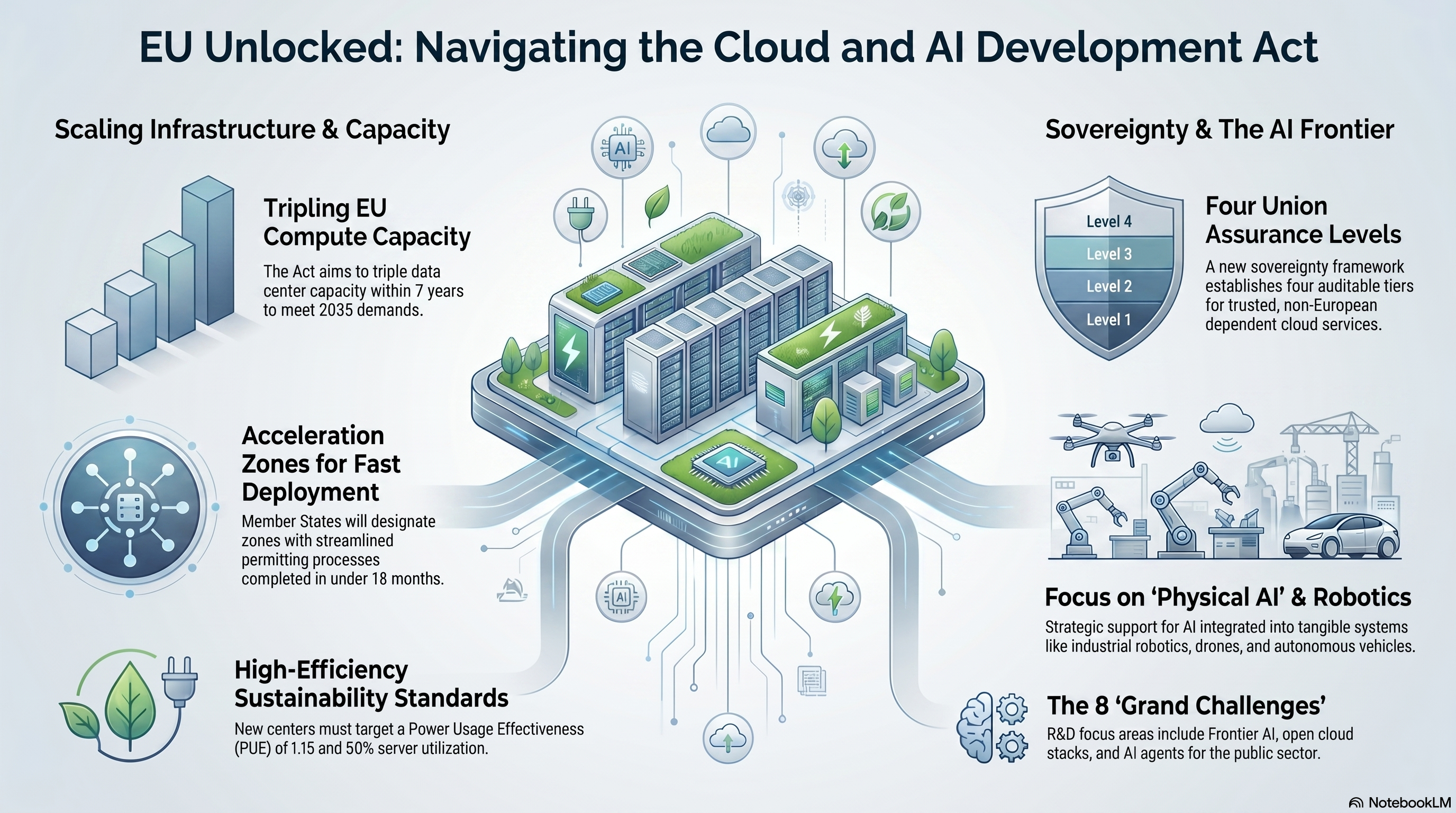
1. The Goal: Tripling Europe’s Compute Capacity
The EU aims to triple its current data centre capacity by 2030. To achieve this, CADA introduces “Data Centre Acceleration Zones” where Member States must ensure that environmental and building permits are granted within a strict 12-month limit. While this promises faster deployment, it raises significant questions regarding energy grid stability and local environmental impacts that will be debated in the Council.
2. The Four-Tier Sovereignty Framework
CADA establishes a Union cloud computing sovereignty framework consisting of four distinct “Assurance Levels”. These levels rank cloud services based on their degree of “European” control, data localisation, and immunity from third-country extraterritorial laws.
- Level 1: Basic compliance and EU establishment.
- Levels 2–4: Increasing requirements for infrastructure location, personnel citizenship, and mandatory independent audits to prevent “sovereign-washing”.
3. Article 30: The Public Procurement Firestorm
The most contentious element for global tech providers and their customers is Article 30. It mandates that public authorities and Union entities only procure cloud services at Levels 2, 3, or 4 for any activity deemed relevant to “public order”. This includes sectors like national security, justice, and health. This provision effectively creates a “Sovereign-First” market that could freeze out non-EU providers from lucrative government contracts.
4. The Unlocked Angle: Beyond Chatbots to “Physical AI”
While the global headlines focus on generative AI, CADA reveals the EU’s real strategic bet: Physical AI. Under Grand Challenge 4, the Act prioritizes specialized hardware and software stacks for autonomous robots, industrial systems, and drones. The goal is to dominate the next wave of industrial automation where Europe already has a strong manufacturing base.
Critical Risks for Your Business
The Cloud and AI Development Act is not just a technical regulation; it is a profound realignment of the European digital market. If passed in its current form, businesses face several imminent risks:
- Procurement Disruptions: If your service provider is classified at a low Sovereignty Level, you may be disqualified from public sector tenders or “critical” supply chains.
- Compliance Costs: The requirement for independent third-party audits and potential migration to sovereign providers within 12 months of a risk assessment could impose massive operational burdens.
- Market Fragmentation: Divergent national implementations of “Acceleration Zones” and risk assessments could complicate cross-border operations for data centre operators.
Is your business strategy aligned with the EU’s new sovereignty tiers?
The legislative process in the European Parliament and the Council is just beginning. Now is the time to influence the file to ensure it supports innovation rather than creating unworkable barriers.
I am ready to help you navigate these risks and develop a bespoke public affairs strategy to engage with EU decision-makers effectively.
Use the contact form below to contact me for a confidential 30‑minute consultation where we will:
- Review which articles most directly threaten your business.
- Map your current EU advocacy assets (or lack thereof).
- Outline a tailored influence plan for the Parliament and Council debates.
Website contact form: hyperion-tree-digital.eu/contact/
Direct calendar link: calendly.com/harold-hyperion-tree-digital/30min
Let’s unlock your influence in Brussels.



Harold Tor-Daenens
Managing Director
With over two decades of experience in international and EU affairs, Harold assists clients in influencing the most difficult legislative files. He possesses a business mindset and a strategic vision backed by data-driven insights. A master of communications and digital channels, he crafts policy narratives that resonate with the intended audiences. Hyperion Tree Digital works in a network of cooperatives of like-minded independent consultancies with presence throughout Europe and the rest of the world, so that our services are affordable, agile and impactful.