
Your business is about to be reshaped by Brussels. Here’s how.
On 4 March 2026, the European Commission published its proposal for a Regulation establishing a framework of measures for the acceleration of industrial capacity and decarbonisation in strategic sector – informally known as the Industrial Accelerator Act (IAA) . The proposal is now undergoing scrutiny by the European Parliament and the Council. If adopted largely as written, it will impose binding local content and low-carbon requirements on public procurement and state-funded projects across the EU.
For businesses that export to the EU, supply critical materials, or rely on EU public contracts, the IAA presents not an opportunity – but an existential risk to market access and cost structures.
This article gives you the verified facts from the legal text (including Annexes II and III), the political battlegrounds, and the specific risks your business faces. And it tells you how I can help you influence this file before trilogues conclude.
The Problem The Commission Wants To Solve.
Why the EU is pushing this: from 17.4% to 14.3% – and the 20% target.
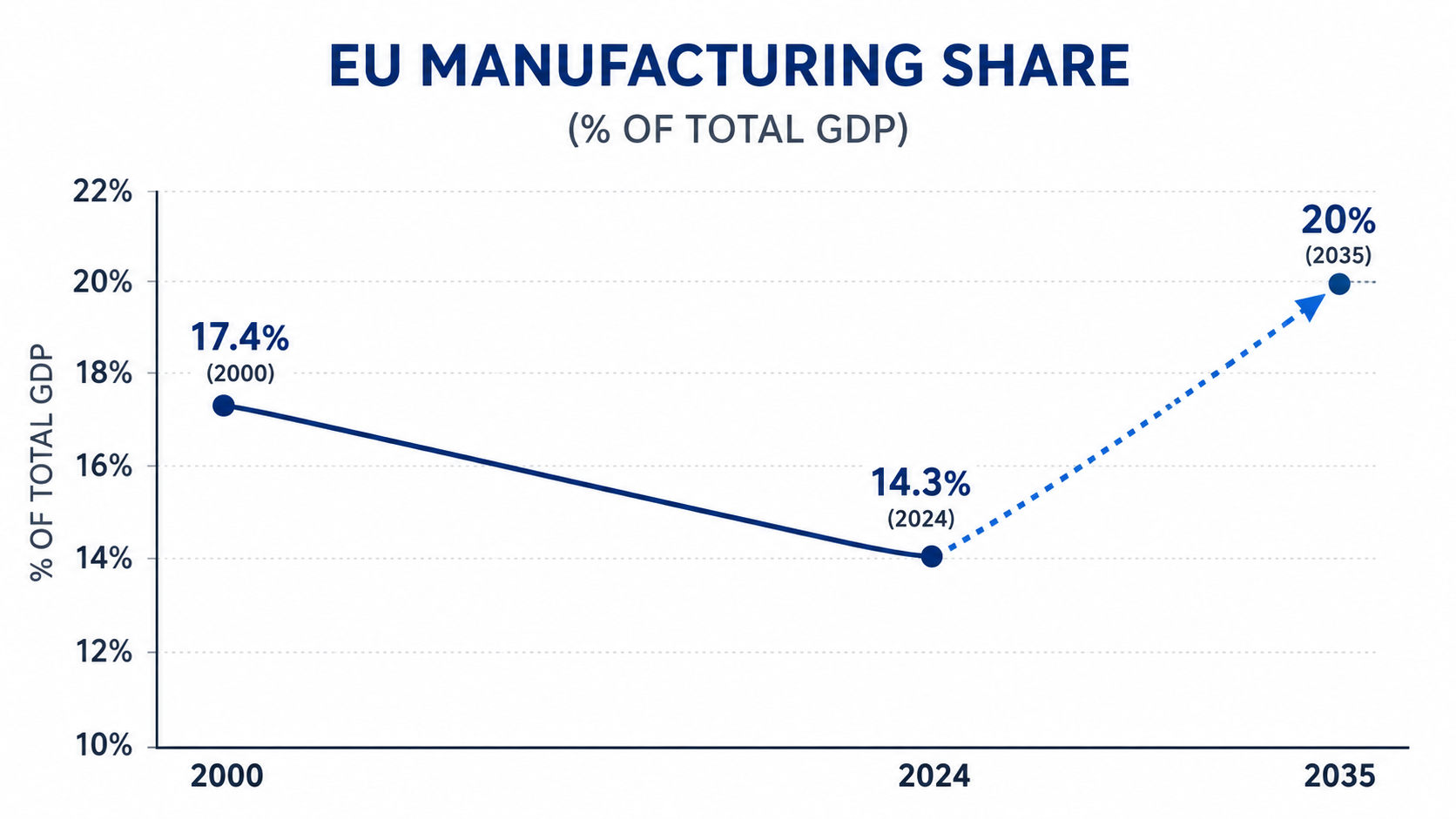
The European Commission cites a long-term decline in EU manufacturing value added as a share of GDP: from 17.4% in 2000 to 14.3% in 2024. The stated goal of the IAA is to reverse that trend and reach 20% by 2035.
The official rationale: high energy prices, subsidised imports (notably from China), and strategic dependencies in clean tech and batteries are gutting European industry. The IAA is presented as a response to the US Inflation Reduction Act and Chinese state-led overcapacity.
But for non-EU manufacturers and even some EU-based companies with global supply chains, this “industrial accelerator” looks like a protectionist wall.
What The Proposal Actually Does
5 binding provisions that will hit your business
Based on the proposal and its annexes (COM(2026)100, Annexes II and III), here are the concrete, non-negotiable elements:
1. Public procurement quotas for energy-intensive materials (from 1 January 2029)
Any EU-funded infrastructure project – bridges, roads, public buildings – must source:
| Material | Minimum requirement |
|---|---|
| Steel | 25% low-carbon |
| Aluminium | 25% low-carbon AND of Union origin |
| Concrete / mortar | 5% low-carbon AND of Union origin |
Source: Annex II, Part I, points (a), (b), (c).
If your company supplies steel, aluminium, or construction materials from outside the EU – or from EU plants that cannot prove low-carbon status – you will be locked out of a vast public procurement market estimated at €2 trillion annually.
2. EV local content rules for public procurement and corporate fleets
For electric vehicles purchased through public procurement or corporate fleet support schemes (from six months after entry into force):
- Assembly must occur within the Union.
- 70% of vehicle components (excluding battery) by ex-works price must originate in the Union.
- The traction battery must contain at least three main components originating in the Union, including battery cells.
- After three years, the requirement tightens: five battery components including cathode active material and battery management system.
Source: Annex III, Part I (public procurement) and Part II (corporate fleet support).
If you are an EV manufacturer, battery supplier, or component maker based outside the EU – or even inside the EU but reliant on non-EU cells or cathodes – your cost base will rise dramatically, and your eligibility for EU green subsidies will vanish.
3. “Super credits” for small zero-emission vehicles
A separate, less stringent regime applies to small EVs (subcategory M1E), but the general direction is the same: local assembly plus either 70% components or three EU battery parts.
4. Single digital window for permits
The IAA amends Regulation (EU) 2018/1724 to create a single contact point for industrial permits. While intended to cut red tape, this centralisation also means tighter monitoring of compliance – making it harder to circumvent local content rules.
5. Delegated acts to set standards for “low-carbon”
Crucially, the definition of “low-carbon” for steel, aluminium, and concrete is not in the main text. It will be defined in future delegated acts under the Ecodesign for Sustainable Products Regulation (ESPR). This creates regulatory uncertainty – the goalposts can move without a full legislative process.
The Political Battle Ahead – Where To Influence
Parliament, Council, and the one article that will decide everything
The legislative process is only beginning. Based on feedback patterns and political fault lines:
- European Parliament: The EPP (centre-right) is broadly supportive but wants weaker local content for allies. S&D and Greens want stricter decarbonisation timelines. Renew and ECR are split between free traders (Dutch/German liberals) and protectionists (Polish ECR). The most contested article will be Annex III’s battery component rules – specifically the 3‑year transition to 5 components including cathodes.
- Council of the EU: Will be debated in the Competitiveness Council (internal market and industry). Germany, Sweden, and the Netherlands will push to weaken local content quotas. France, Italy, and Southern member states want to strengthen them. The likely compromise: maintain quotas but relax the EU origin requirement for aluminium and concrete, or extend transition periods.
- Most contentious single concept: The definition of “low-carbon” – if it is set too stringently (e.g., near-zero emissions), even EU producers may fail to comply. If set too loosely, the whole mechanism becomes a fig leaf.
Your window to influence is now. The Commission proposal is on the table. Parliament committees (likely ITRE – Industry, Research and Energy) will draft reports in late 2026. Council working groups are already meeting. Trilogues are expected in mid-2027.
Risks For Your Business – Why You Should Act Now
Three immediate risks the IAA creates for your bottom line
If your company is a manufacturer, raw material supplier, component maker, or trade association – whether based inside or outside the EU – here is what the IAA means for you:
Risk 1: Market exclusion from €2 trillion in public procurement
From 2029, if your steel, aluminium, concrete, or EV cannot meet the 25% / 5% low-carbon thresholds and (for aluminium and concrete) the Union origin rule, you will be ineligible for any EU-funded public contract. This includes not only direct government purchasing but also privately financed projects that receive EU subsidies (e.g., cohesion funds, recovery funds).
Risk 2: A 3‑year cliff edge for battery supply chains
The EV battery rules look manageable at first (3 EU components including cells). But the automatic tightening after three years to 5 components including cathodes – for which Europe currently has minimal production capacity – means that even EU-based EV makers may fail to comply. This creates a supply chain bottleneck and will force costly re‑localisation or joint ventures.
Risk 3: Regulatory whiplash from delegated acts
The “low-carbon” definition is delegated to the ESPR process. This allows the Commission to change the standard without Parliament/Council approval. A sudden tightening could make today’s compliant product tomorrow’s non‑compliant one – with no grandfathering.
Additional risks: Compliance costs for SMEs, trade retaliation from WTO partners (China, US), and a two‑tier EU market where only large incumbents can afford to certify every ton of material.
How I Can Help – Influence The File Before Trilogues
You don’t have to accept the proposal as written. But you must act now.
The IAA is not yet law. The European Parliament and Council will amend it. This is where strategic public affairs makes the difference.
I offer bespoke consultancy services for clients who face material risk from this legislative proposal:
- Risk assessment: A full audit of your supply chain and market access against each article of the IAA (including annexes).
- Stakeholder mapping: Identification of key rapporteurs, shadow rapporteurs, Council working party leads, and Commission officials.
- Position paper drafting: Submission of formal feedback to the Parliament and Council, framed to protect your commercial interests.
- Coalition building: Connecting you with trade associations, national missions, or regional governments that share your concerns.
- Amendment strategy: Targeted language changes to dilute, delay, or carve out exemptions for your sector (e.g., SMEs, specific materials, longer transition periods).
Why me? I am a Brussels-based policy analyst with direct experience in industrial, trade, and climate files. I do not guess – I verify against legal texts. And I know precisely which doors to knock on in the Berlaymont, the Parliament, and the Council.
Contact Me
The trilogue clock is ticking. Contact me today.
Do not wait for the final text to be published. By then, your competitors will have already shaped the rules in their favour.
Use the contact form below to schedule a confidential 30‑minute briefing:
- A 30‑minute briefing on the specific risks to your sector.
- A preliminary mapping of where your interests sit on the political fault lines.
- A proposed engagement plan with clear milestones and budget options.
Website contact form: hyperion-tree-digital.eu/contact/
Direct calendar link: calendly.com/harold-hyperion-tree-digital/30min
Let’s unlock your influence in Brussels.



Harold Tor-Daenens
Managing Director
With over two decades of experience in international and EU affairs, Harold assists clients in influencing the most difficult legislative files. He possesses a business mindset and a strategic vision backed by data-driven insights. A master of communications and digital channels, he crafts policy narratives that resonate with the intended audiences. Hyperion Tree Digital works in a network of cooperatives of like-minded independent consultancies with presence throughout Europe and the rest of the world, so that our services are affordable, agile and impactful.